
Moisture Damage in Asphalt: Understanding TSR Testing and Why It Matters
Moisture damage is one of the most misunderstood failure mechanisms in asphalt pavements.
It often shows up as stripping, ravelling, or aggregate exposure at the surface. But by the time these signs appear, the real damage has already occurred internally.
At the centre of this issue is one critical concept:
The bond between the asphalt binder and the aggregate.
This blog explains how engineers evaluate that bond using the Tensile Strength Ratio (TSR) test, and why it is essential for long term pavement performance.
🌧️ What is Moisture Damage in Asphalt?
Moisture damage occurs when water infiltrates the asphalt mix and weakens the adhesive bond between the binder and aggregate.
This leads to:
• Loss of cohesion within the mix
• Reduced load transfer capability
• Progressive stripping and material loss
• Increased susceptibility to rutting and cracking
It is not just a surface issue. It is a structural durability problem.
🧪 What is the TSR Test?
The Tensile Strength Ratio (TSR) test is a laboratory method used to evaluate the moisture susceptibility of asphalt mixtures.
It compares the tensile strength of:
• Unconditioned samples: dry, baseline strength
• Conditioned samples: moisture exposed, simulated field damage
The goal is simple:
Measure how much strength the mix retains after moisture exposure.
⚙️ How the TSR Test Works
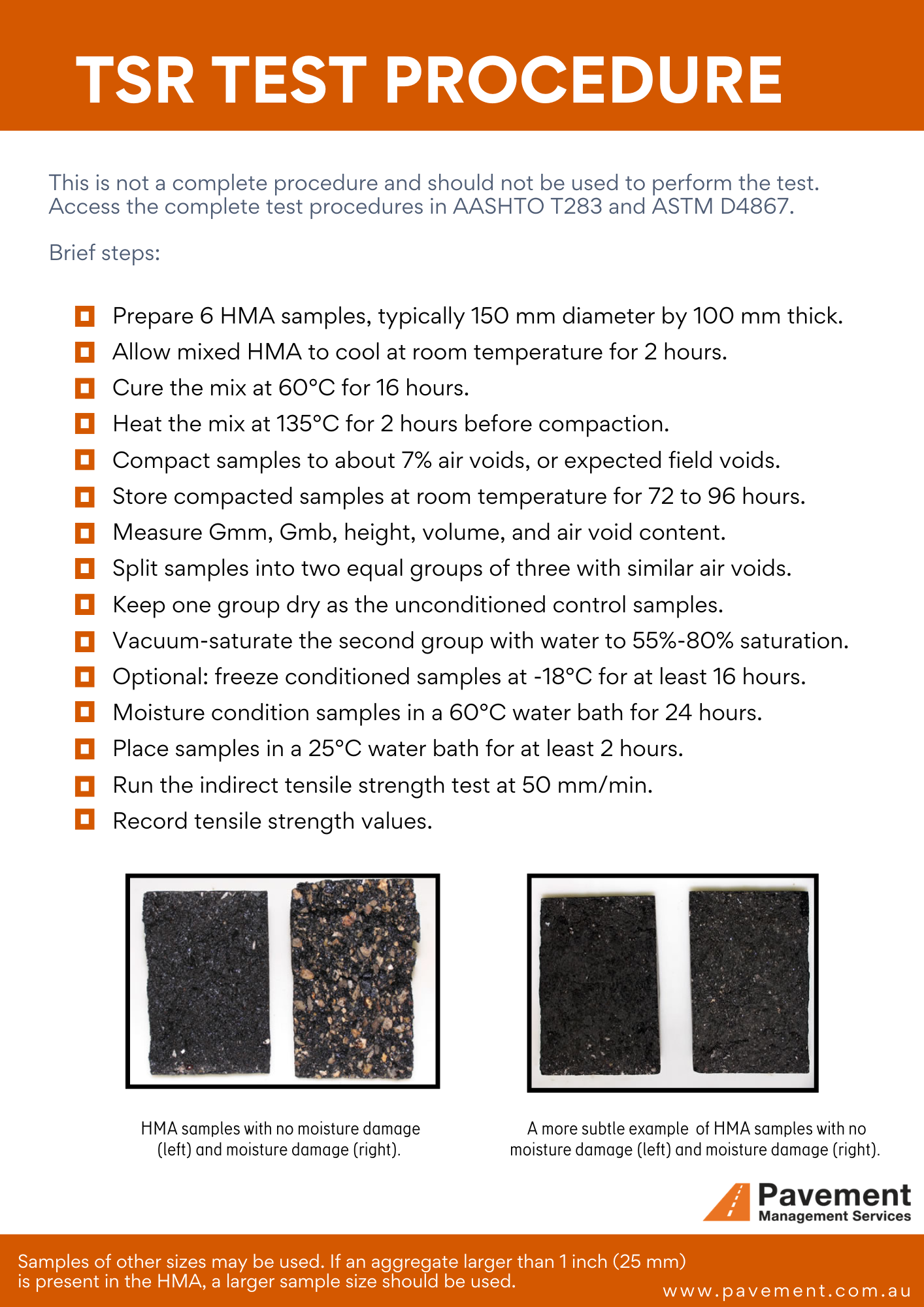
The procedure simulates severe environmental conditions that asphalt may experience in the field:
• Samples are compacted to target air voids (typically around 7 percent)
• One set remains dry as the control
• The other set is vacuum saturated with water
• Samples may undergo freeze conditioning at minus 18°C
• They are then placed in a hot water bath at 60°C
• Finally, all samples are tested using indirect tensile strength
This process accelerates moisture damage in a controlled environment.
📊 Understanding TSR Results
TSR is calculated as:
TSR = Conditioned Strength ÷ Unconditioned Strength
This ratio indicates how well the asphalt mix resists moisture induced damage.
Typical interpretation:
• TSR ≥ 0.80: good moisture resistance
• TSR 0.70 to 0.80: marginal performance
• TSR < 0.70: high moisture susceptibility
⚠️ What TSR Really Tells You
The TSR value is not just about strength.
It reflects the integrity of the binder–aggregate bond under moisture exposure.
• High TSR: bond remains intact, mix is durable
• Low TSR: bond weakens, risk of stripping increases
This directly impacts pavement life.
🔍 Common Issues in Moisture Damage Testing
TSR results are only reliable if the procedure is followed precisely.
Common sources of error include:
• Incorrect saturation levels
• Poor temperature control during conditioning
• Inconsistent air void distribution between samples
• Over or under conditioning of specimens
These deviations can lead to misleading results and poor design decisions.
🏗️ Why TSR Matters in Pavement Engineering
A mix can meet all design requirements on paper.
But if it cannot resist moisture, it will fail prematurely.
TSR testing helps engineers:
• Identify moisture-susceptible mixes early
• Validate the need for anti-stripping agents or lime treatment
• Improve durability and lifecycle performance
• Reduce maintenance costs and early failures
💡 Key Takeaway
Moisture damage is not about what you see on the surface.
It is about whether the asphalt mix can maintain its internal bond under real-world conditions.
TSR testing bridges the gap between laboratory design and field performance.
📥 Want to learn more about pavement engineering and asset management strategies?
Explore more resources from Pavement Management Services.