
Smoothness and Texture Are Not the Same Thing
A road can be brand new, perfectly built, and still feel rough. A road can feel like glass under your tyres and still be dangerous in the rain. Most people assume these two things move together, that a smooth road is a good road and a coarse road is a rough one. They do not, and the gap between them is one of the most useful ideas in pavement engineering.
Two separate properties are doing the work under your tyres. Confuse them, and you end up blaming the wrong thing when a road disappoints you, or worse, fixing the wrong thing when you maintain it.
The two properties, and why they are differen
The first property is smoothness. This is about ride quality, the unevenness you feel along the length of the road as you drive. Engineers measure it with the International Roughness Index, or IRI. A low IRI means a smooth, comfortable ride. A high IRI means a bumpy one. The key thing to understand is that IRI is a profile property. It describes the shape of the road over distance, the long waves and dips your suspension has to absorb. You cannot capture it in a single photo, because a road that looks flat in a snapshot can ride terribly, and a road that photographs fine can still bounce you the whole way.
The second property is texture. This is the surface itself, the grain your tyre actually grips. Engineers talk about macrotexture, the coarseness you could feel by running your hand across the surface. Texture is what gives a tyre something to bite into, and it is what channels water out from under the tyre in the wet. High texture means strong grip and good drainage. Low texture means a quieter, smoother-feeling surface, but less grip when it rains.
Here is the part that trips people up. Smoothness is measured over the length of the road. Texture is measured at a single spot on the surface. They are two different things, recorded by two different methods, and they move independently of each other. Smooth is not the opposite of coarse. Rough is the opposite of smooth, and fine is the opposite of coarse. Each property has its own axis.
The four combinations
Once you accept that smoothness and texture are independent, a simple truth follows. A pavement can be any combination of the two. There are four, and laying them out in a matrix is the clearest way to see why the distinction matters.
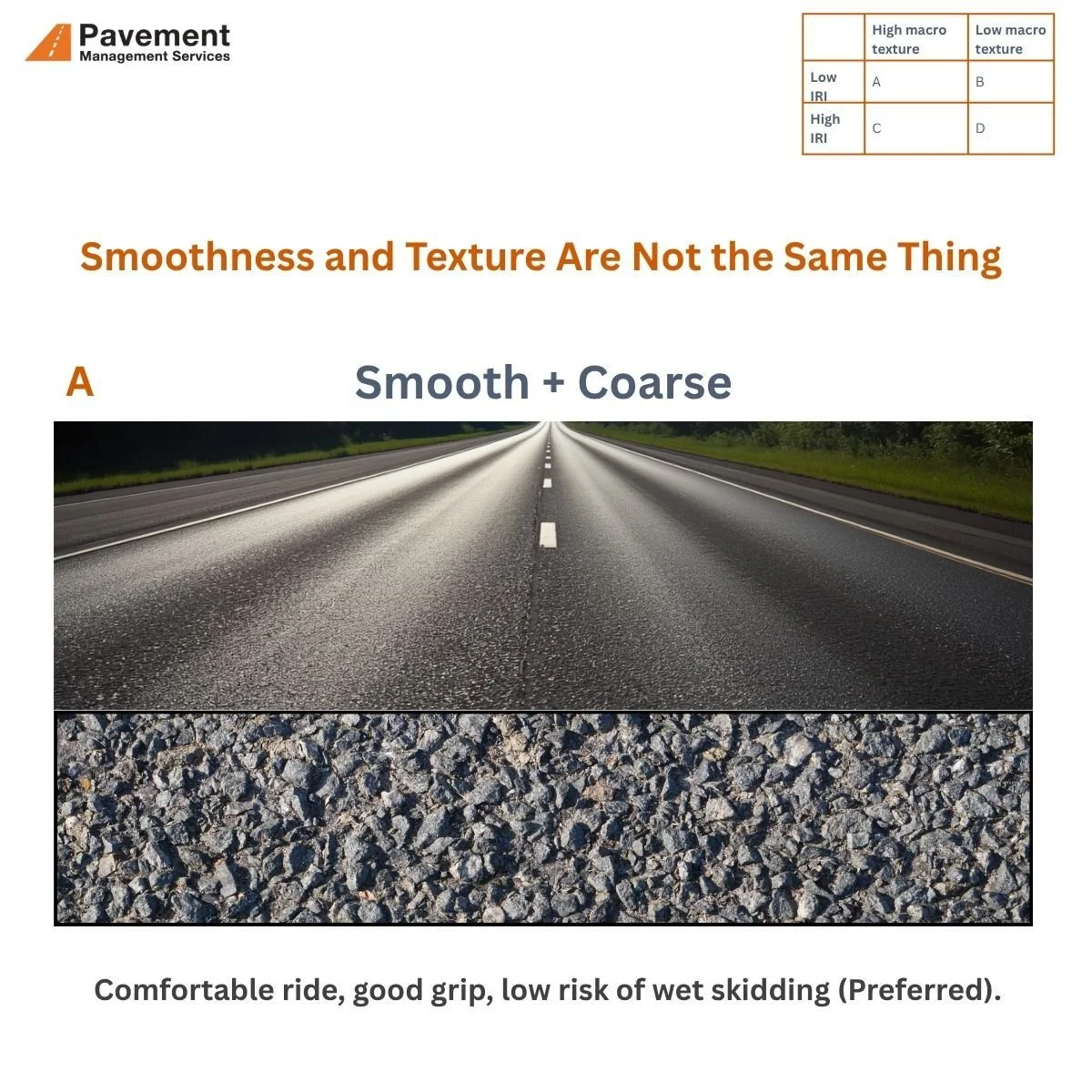
A. Smooth and coarse (low IRI, high texture). A comfortable ride with strong grip and good drainage. This is the combination good roads aim for. You get the comfort of an even profile and the safety of a textured surface at the same time. This is the target.
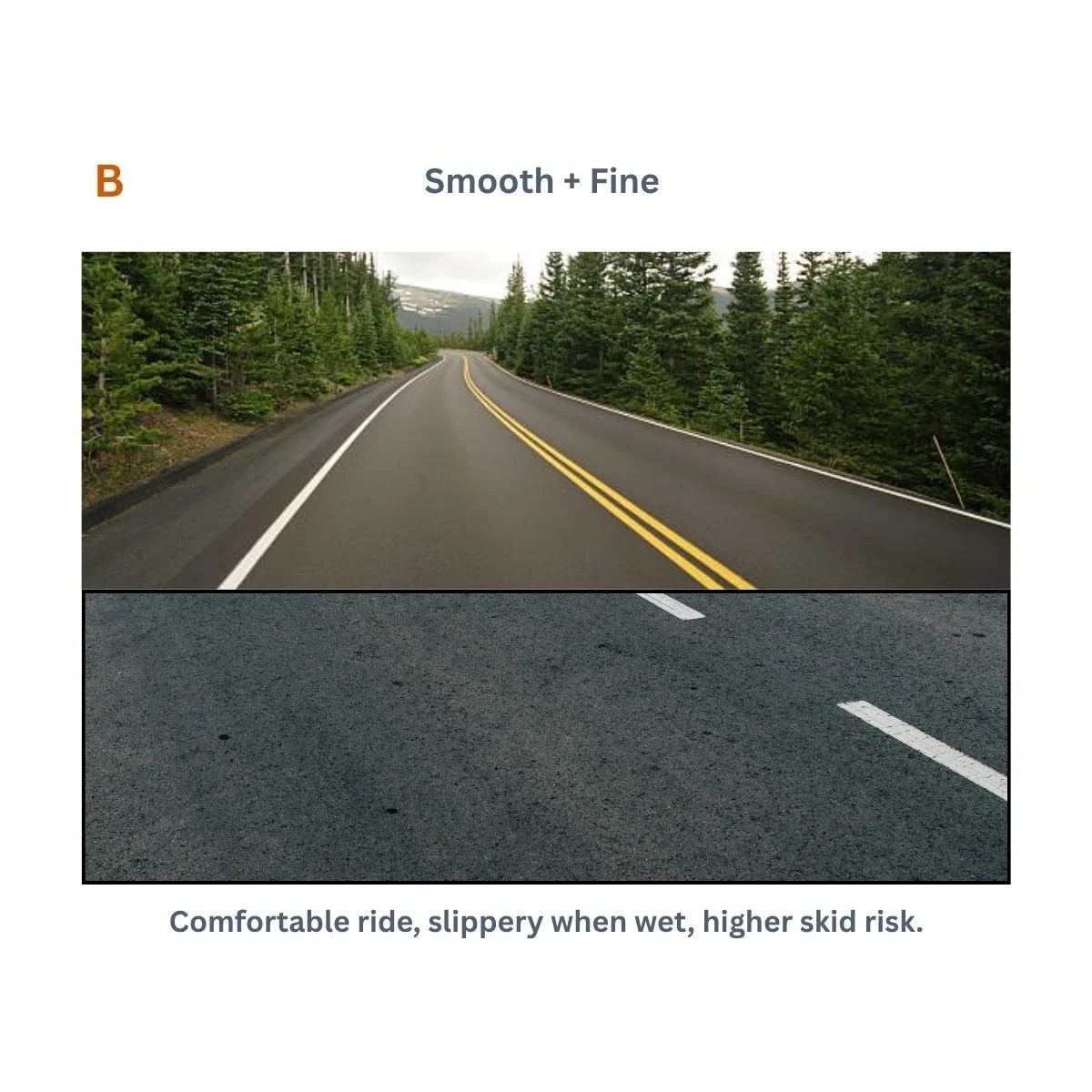
B. Smooth and fine (low IRI, low texture). Comfortable and quiet, but the low texture means less grip when the surface is wet. This combination carries the highest skid and hydroplaning risk of the four. It can be acceptable where speeds are low or drainage is well managed, but the smooth, glassy feel hides a real wet-weather weakness.
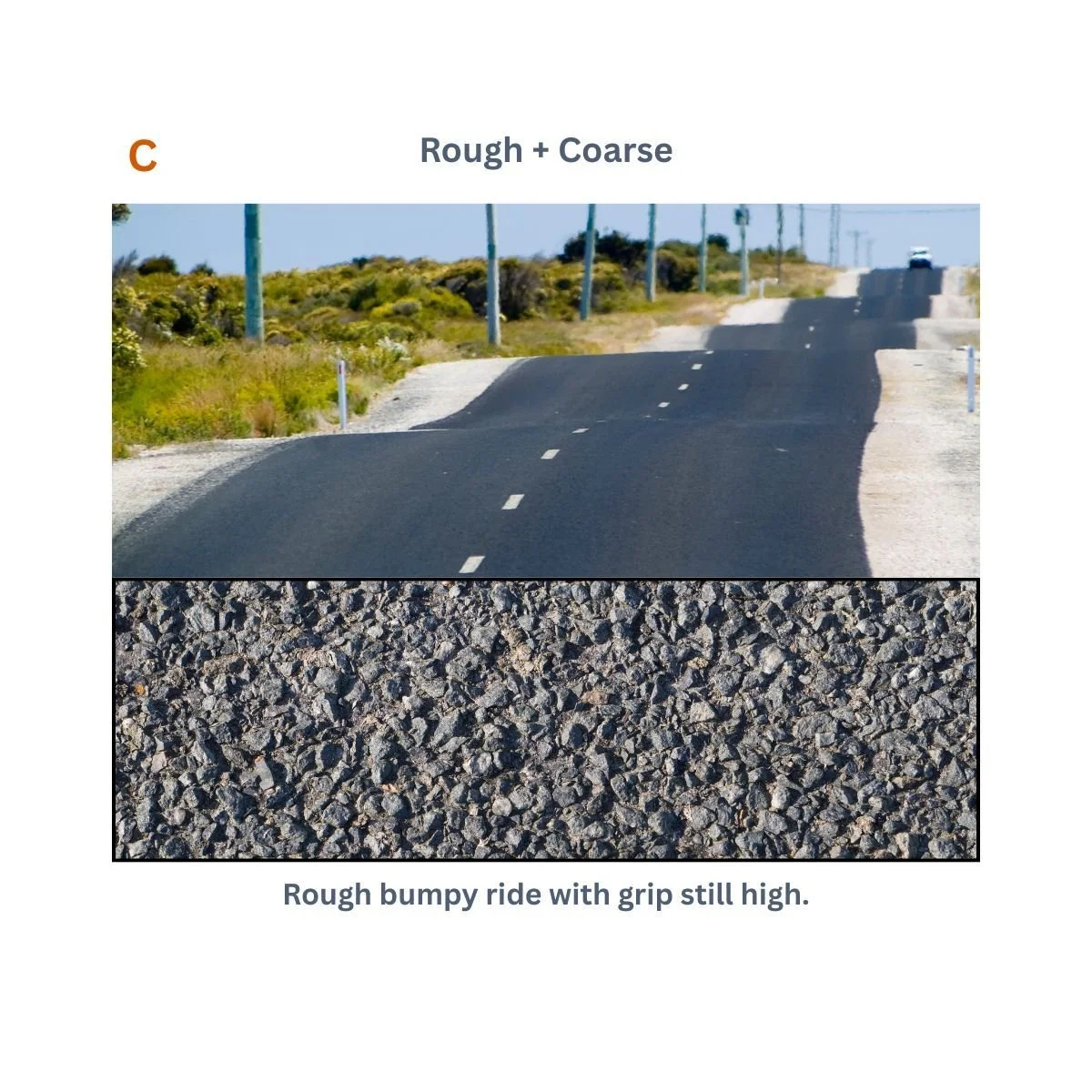
C. Rough and coarse (high IRI, high texture). A bumpy ride, because the profile is uneven, but the surface still grips well and clears water. The comfort is gone, yet the wet-weather safety remains. Note that roughness here means an uneven, wavy profile, not potholes. Potholes are surface failure, a structural problem, which is a different issue again from either IRI or texture.
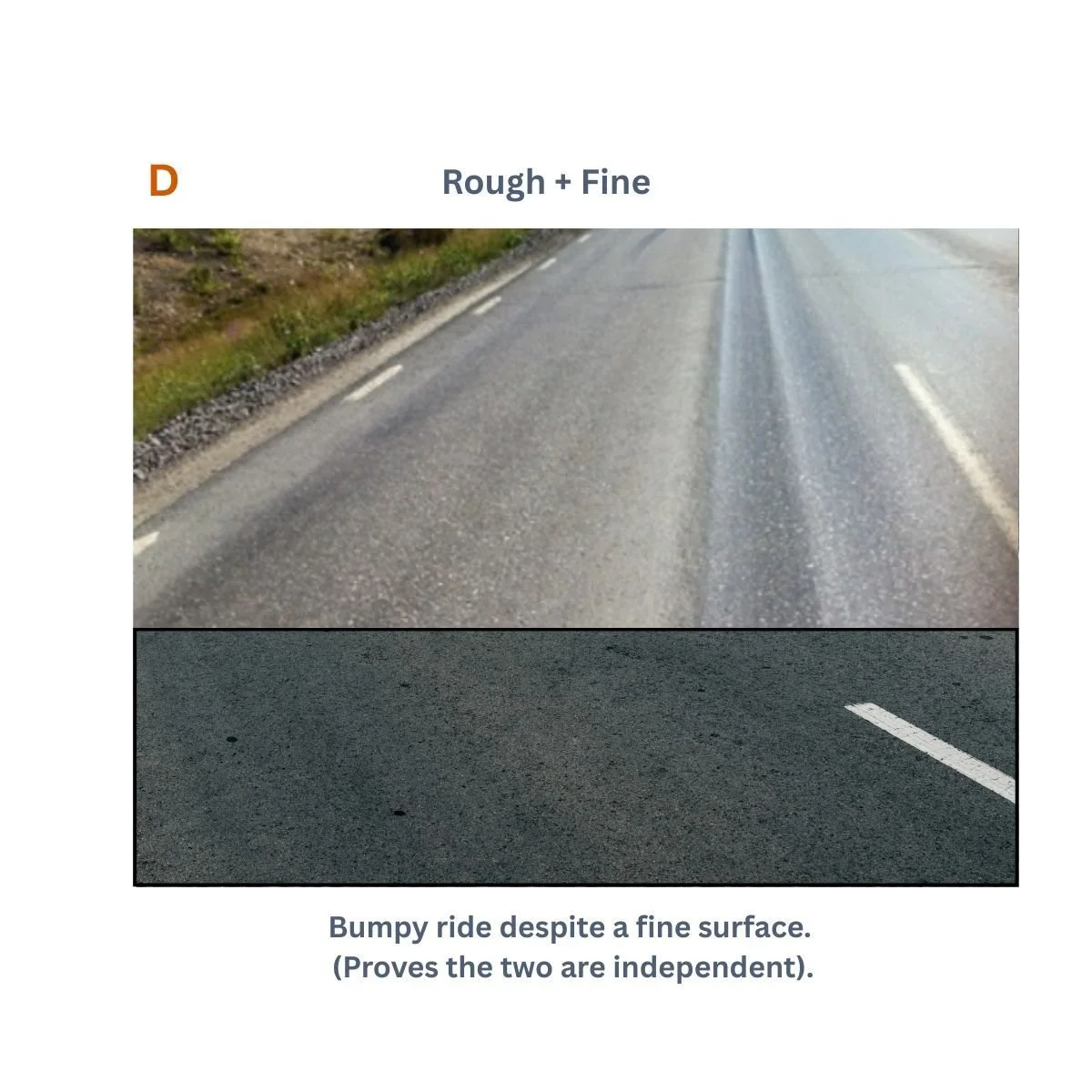
D. Rough and fine (high IRI, low texture). A bumpy ride and weaker wet grip. This is the combination that proves the point most clearly. The surface looks and feels fine and smooth to the touch, yet the ride is still rough, because ride quality lives in the profile, not the texture. It shows beyond argument that the two properties are independent.
The detail most people miss
Look closely at where wet-weather safety sits in those four cells. It does not follow the smooth-versus-rough split. It follows the texture split. A and C are both coarse, so both grip well and drain well in the rain, regardless of how the ride feels. B and D are both fine, so both carry higher skid risk, again regardless of the ride.
That is the practical heart of the matter. Ride comfort is driven by smoothness. Wet safety and grip are driven by texture. A road can be a joy to drive and a hazard in the rain, or a teeth-rattler that grips beautifully. If you judge a road only by how it feels through the seat of your car, you are reading just one of the two dials.
Why this matters beyond the drive
For anyone who builds, maintains, or manages roads, this distinction is not academic. It changes the decision you make.
If a road is uncomfortable, that is a smoothness problem, and the fix lives in the profile, in correcting the unevenness. If a road is losing grip or struggling in the wet, that is a texture problem, and the fix lives in the surface. Resurfacing a perfectly textured but bumpy road with a smooth fine layer might improve the ride and quietly reduce wet safety at the same time. Diagnose the wrong property, and you can spend a budget making one thing better while making another worse.
Good pavement management measures both, separately. Ride quality and surface texture are tracked as distinct indicators, because they tell you about distinct things: comfort and fuel use on one side, grip and drainage and safety on the other.
The takeaway
Smoothness and texture are not the same thing, and they are not opposites. They are two independent properties of every road you drive. One is about the shape of the road over distance. The other is about the grain of the surface under your tyre. The best roads score well on both: smooth enough to ride comfortably, textured enough to grip safely.
So the next time a road feels right, or feels wrong, ask which of the two it really is. The answer is usually more interesting than smooth or rough.